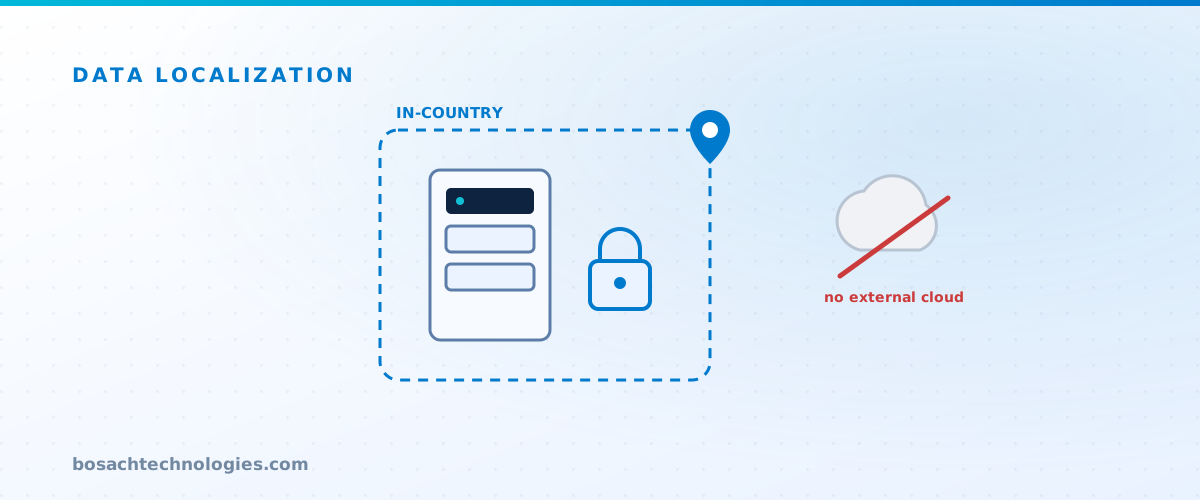
Banks are adding AI to ATM operations fast — predicting failures, spotting fraud, answering questions about the fleet. But every one of those capabilities runs on data, and that raises a question compliance teams ask before anything else: where does the data go? For regulated banking, "a vendor's cloud in another country" is often the wrong — and sometimes illegal — answer.
The data-localization mandate
Rules like the Reserve Bank of India's data-localization requirement mean payment-system data has to be stored within the country, and similar mandates exist across many jurisdictions. Even where the law is looser, bank security and risk teams are increasingly unwilling to let sensitive operational data leave their control. Streaming ATM telemetry — or worse, customer interactions — to a foreign cloud AI service is, for a lot of institutions, simply a non-starter.
Why "cloud AI" is a poor fit for the ATM edge anyway
Regulation aside, the cloud is an awkward home for ATM intelligence. Connectivity at cash machines is uneven; anything that depends on a round-trip to a distant service is fragile exactly when it's needed; and routing fleet data through an external platform expands the attack surface and the compliance burden at the same time. The edge wants intelligence that lives close to the machines.
Air-gapped, on-premise AI
The answer is to run the intelligence inside the bank's own perimeter — on-premise, and air-gapped where required, so fleet data never crosses the boundary. That's a design principle across the BOSACH suite: SentIQ's natural-language analytics and EdgeSentinel's monitoring are built to operate on-premise and air-gapped; camera-based detection runs inference on the device; and voice guidance is generated offline on the ATM. The intelligence comes to the data, not the other way around.
You don't have to trade capability for control
The old assumption was that serious AI meant the cloud, and keeping data in-house meant settling for less. That's no longer true. Failure prediction, plain-language fleet queries, on-device vision — these can all run within your walls. We wrote about the querying side in Ask Your Fleet: an operator can ask questions in natural language and get grounded answers without a single byte of fleet data leaving the environment.
Build for compliance from day one
Data localization isn't only about where data sits — it's about proving it. That means retention aligned to local rules (for Indian estates, RBI-aligned), clear audit trails of who accessed what, and role-based access control throughout. Treating those as foundations rather than afterthoughts is what turns "we think we're compliant" into something you can actually show a regulator.
The bottom line
AI at the ATM and strict data control are not in tension — as long as the intelligence is built to run where the data already lives. For banks under localization mandates, air-gapped, on-premise AI is the way to get predictive monitoring, natural-language analytics and vision without handing sensitive data to someone else's cloud. Capability and control, in the same box.