🧠 SentIQ
Predict. Prevent. Perform.
The AI intelligence layer inside EdgeSentinel. SentIQ baselines each ATM's normal behaviour, detects anomalies, predicts hardware failures up to 72 hours ahead, and scores SLA breach risk — before your customers notice anything. And with natural-language querying, your team can just ask — in plain language — which machines need attention and why.
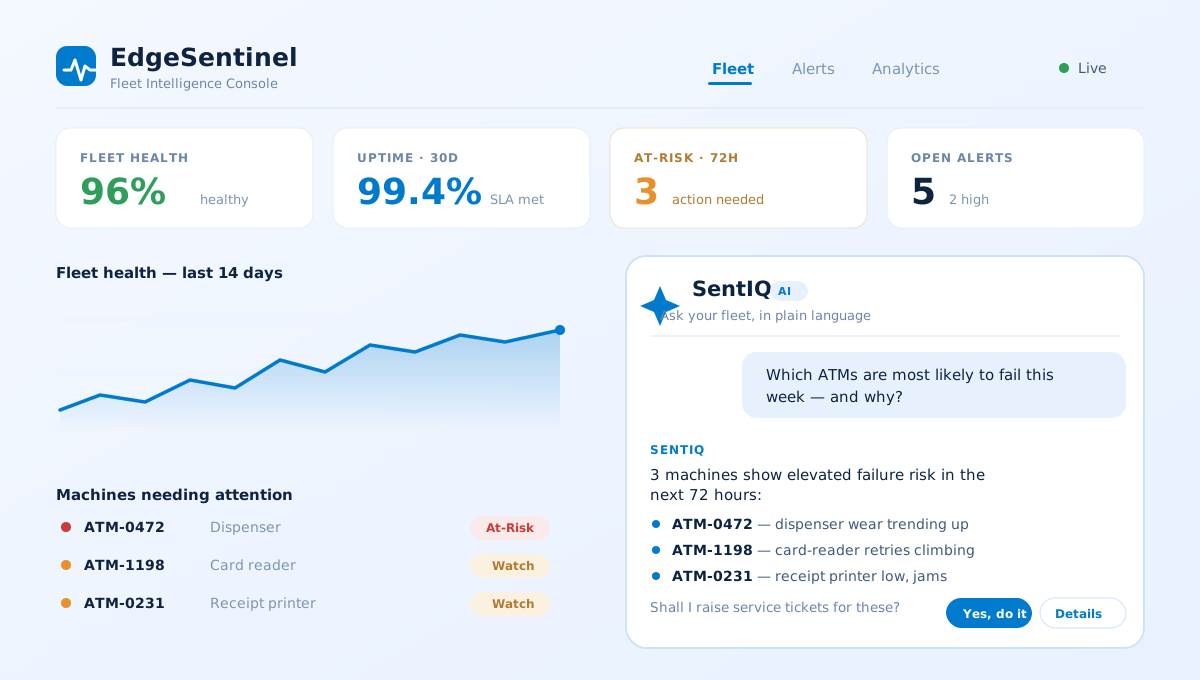
AI You Can Just Ask
Your operations team shouldn't need to be data analysts. SentIQ layers natural-language querying over the EdgeSentinel dashboard — ask about your fleet in plain language and get ranked, explained answers, with the option to act. For air-gapped or on-premise banking environments, it runs entirely inside your own perimeter.
From Raw Telemetry to
Actionable Predictions
SentIQ processes multi-layer telemetry from Edge Signal Agents, builds behavioural models per ATM, and produces ranked, actionable intelligence for operations teams.
Ingest Telemetry
Real-time streams from Edge Signal Agents: XFS device states, OS health, application logs, network signals, transaction outcomes
Build ATM Baselines
Per-ATM, per-time-of-day, per-load normal behaviour models. What is "normal" for ATM #1234 on Monday mornings vs. Friday peak?
Detect Anomalies
Continuous comparison of live telemetry against baselines. Cross-signal correlation: a dispenser latency drift + retry spike = significant signal
Score Failure Risk
Predictive failure probability per component per ATM — for the next N hours and days. Hotspot detection across the fleet.
Recommend Actions
Next-best actions with evidence: "schedule preventive maintenance before Friday peak" — with one-click execution via EdgeSentinel
What SentIQ
Can Do For Your Fleet
SentIQ goes beyond alert rules. It learns, it adapts, and it gets smarter the longer it runs on your ATM estate.
Per-ATM Behavioural Baselining
Learns what "normal" looks like for each individual ATM — by location, load, time-of-day, and transaction mix. Not just fleet-wide averages.
Cross-Signal Anomaly Detection
Correlates device errors, OS health, network signals, and transaction patterns simultaneously. Single signals that look innocuous become meaningful in combination.
Predictive Failure Scoring
Assigns a failure probability to each ATM and component for the next N hours/days — not just "is it broken now" but "will it break soon?"
SLA Breach Risk Forecasting
Predicts which ATMs are likely to breach their SLA window before it happens — giving operations time to act.
Fleet Hotspot Detection
Surfaces patterns across regions, vendors, ATM models, and components — "this component fails most often in Chennai ATMs after humid season."
Closed-Loop Learning
SentIQ learns from outcomes: when a predicted failure did or didn't occur, it updates its models — continuously improving accuracy over time.
SentIQ Outputs to Operations
What your NOC and field teams actually receive
SentIQ in Action:
Cash Dispenser Failure Prediction
Illustrative example showing how SentIQ correlates signals over 72 hours to predict and prevent a dispenser failure before customer impact.
Signals Observed Over 72 Hours
ATM #4281 — Branch: Chennai South — Dispenser unit
With SentIQ: Preventive maintenance Thursday afternoon. Zero customer impact. Planned visit. 45-min repair.
Operational Outcomes with SentIQ
Higher ATM Availability
Prevent failures before they happen — turn reactive outages into planned maintenance windows.
Lower MTTR
Correlated incident timelines and right-part dispatch reduce mean time to resolution dramatically.
Reduced Cost Per Incident
Fewer truck-rolls, right-skill dispatch, and remote resolutions cut operational cost per incident.
Stronger SLA Position
Predict breach risk before it happens. Build evidence-backed vendor SLA scorecards with real data.
Less Alert Noise
AI + rules together surface only meaningful alerts — operations teams focus on real problems.
Compounding Improvement
Closed-loop learning means SentIQ gets smarter every month — value increases over time, not decreases.
Let SentIQ Look at Your ATM Data
Share a sample of your ATM telemetry data and we'll show you what SentIQ can predict about your specific fleet — in a structured discovery session.