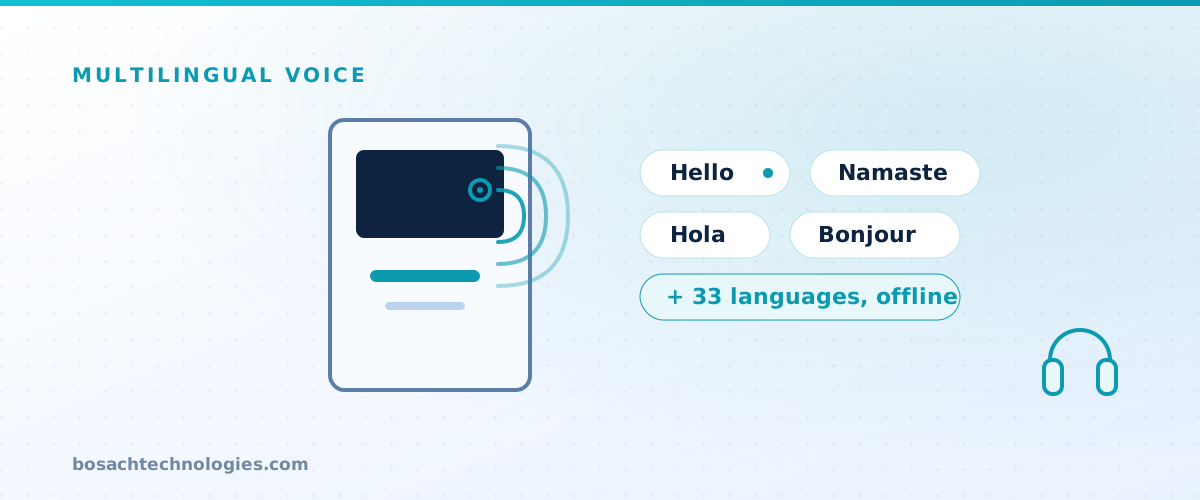
Almost every ATM in the world makes the same quiet assumption: that the person standing in front of it can read the screen — in a language they understand, at a size they can see. For a great many customers, that assumption simply doesn't hold. And when cash access is essential infrastructure, being locked out of it is not a minor inconvenience.
The people a screen-only ATM leaves out
Think about who struggles at a text-only machine: customers who are blind or have low vision; older adults who find small on-screen text hard to read; adults with limited literacy; and — in multilingual regions especially — anyone whose language simply isn't on the screen. India alone has 22 official languages and hundreds of widely spoken ones. A machine that speaks only the two or three languages a bank happened to load quietly turns away everyone else.
What a talking ATM actually does
Voice guidance narrates the transaction, step by step, in the customer's own language — often delivered privately through a headphone jack so a visually impaired user can bank independently and securely. It makes the journey eyes-free and hands-free: the customer is guided by what they hear, not only by what they can read. Done well, it doesn't replace the screen — it runs alongside it, so every customer gets a path that works for them.
From speaking to listening: interactive voice journeys
Everything so far has been about the ATM speaking. The bigger shift is when it can also listen. Adding automatic speech recognition (ASR) turns one-way narration into a genuine two-way conversation: instead of only hearing prompts, the customer can simply say what they want — "withdraw five thousand rupees," "check my balance" — and the machine understands and responds.
This is exactly what now powers the interactive voice journeys in EdgeTerminal. VoizeTTS gives the ATM its voice; ASR gives it ears. Together they let a customer complete a transaction by talking to the machine — guided by spoken prompts and answering out loud — hands-free, eyes-free, and in their own language. And because both the listening and the speaking run in the supported languages, this isn't English voice commands bolted onto a local screen: the whole conversation happens in the customer's language.
For a visually impaired or low-literacy customer, that closes a real gap. Hearing the prompts is assistance; being able to answer them by voice is independence — completing a withdrawal without ever having to find, read, or accurately press the right on-screen button.
Why it has to be offline and on-device
It's tempting to reach for a cloud text-to-speech service, but an ATM is the wrong place for one. Connectivity at a cash machine can be intermittent; a customer waiting for audio to stream over a flaky link is a broken experience; and routing customer interactions through an external service raises real privacy and security questions. The voice has to be generated on the machine, offline — and the same logic applies to the listening half: recognising what a customer says has to happen on the machine too, so spoken instructions never travel to an external service. Both halves of the conversation stay on-device. That's the approach behind VoizeTTS — offline, on-device voice guidance in 33+ languages, including 13+ Indian languages, running today on more than 70,000 ATMs. You can hear a live sample for yourself.
Compliance is the floor, not the ceiling
Accessibility at the ATM isn't only good practice — in many markets it's expected. Regulators, including the RBI in India, have long pushed banks toward talking ATMs, and accessibility standards elsewhere have made voice a requirement rather than a courtesy. But treating it purely as a compliance checkbox misses the bigger opportunity: every customer you make the ATM usable for is a customer you can serve. Multilingual voice is one of the most direct levers a bank has for genuine financial inclusion.
Adding a language shouldn't take years
A practical objection is speed: if serving a new regional population means a multi-year language project, it never happens. It shouldn't. A well-built voice engine can add a new language in a matter of weeks, so a bank can respond to the population it actually serves — not the one its ATM software was originally shipped with.
The bottom line
The ATM is one of the most widely used pieces of self-service technology on earth, and for decades it has spoken to a narrower audience than it needed to. Multilingual, offline voice guidance changes that — quietly extending cash access to the customers a screen alone leaves behind. For a bank, that's compliance, inclusion and reach in a single capability.